


Astrophotographers love gear that punches above its weight. Over the last few years, harmonic drive mounts—also known as strain-wave gear mounts—have moved from industrial robotics into the world of portable imaging, promising high torque, low weight, and smooth guiding without the bulk of traditional worm-gear designs. But what actually makes a harmonic drive mount different, and why has it become the go-to choice for modern, mobile astrophotography?
This guide breaks down the mechanics, the benefits, the trade-offs, and what you can realistically expect in terms of guiding performance.
The Core Idea: Harmonic Drive Mount / Strain-Wave Gear Mechanics
A harmonic drive is built around an elegant concept: instead of rigid gear teeth meshing together, a thin, flexible metal cup—called the flexspline—is slightly deformed as it rotates inside a rigid outer ring. The deformation causes the teeth to engage in a wave-like pattern, producing:
- extremely high gear reduction in a small volume
- negligible backlash (the tiny “slop” you feel in traditional gears)
- very high stiffness, which helps maintain tracking accuracy under load
Because the teeth are always engaged across a broad contact area, the system behaves in a way that’s fundamentally different from worm gears, where tiny misalignments or temperature changes can introduce periodic error.


Why Astrophotographers Care
1. High Torque at Low Weight
Harmonic drives can deliver high torque without bulky counterweights or large housings. This enables ultra-portable mounts that carry surprisingly heavy imaging setups.
2. Zero Backlash
Backlash is the enemy of tracking. Strain-wave gears essentially remove it, which translates into consistent guiding corrections and stable RMS values—especially when paired with shorter guide exposures.
3. Mechanical Stiffness
The structure resists flexure and maintains geometry under changing loads. That’s especially important for long refractors or dual imaging setups.
4. Fast Slews, Stable Tracking
The same reduction that gives strong torque also enables smooth, controlled micro-steps for precise guiding, while still allowing high slew speeds for framing.
Harmonic Drive Mounts for Astrophotography
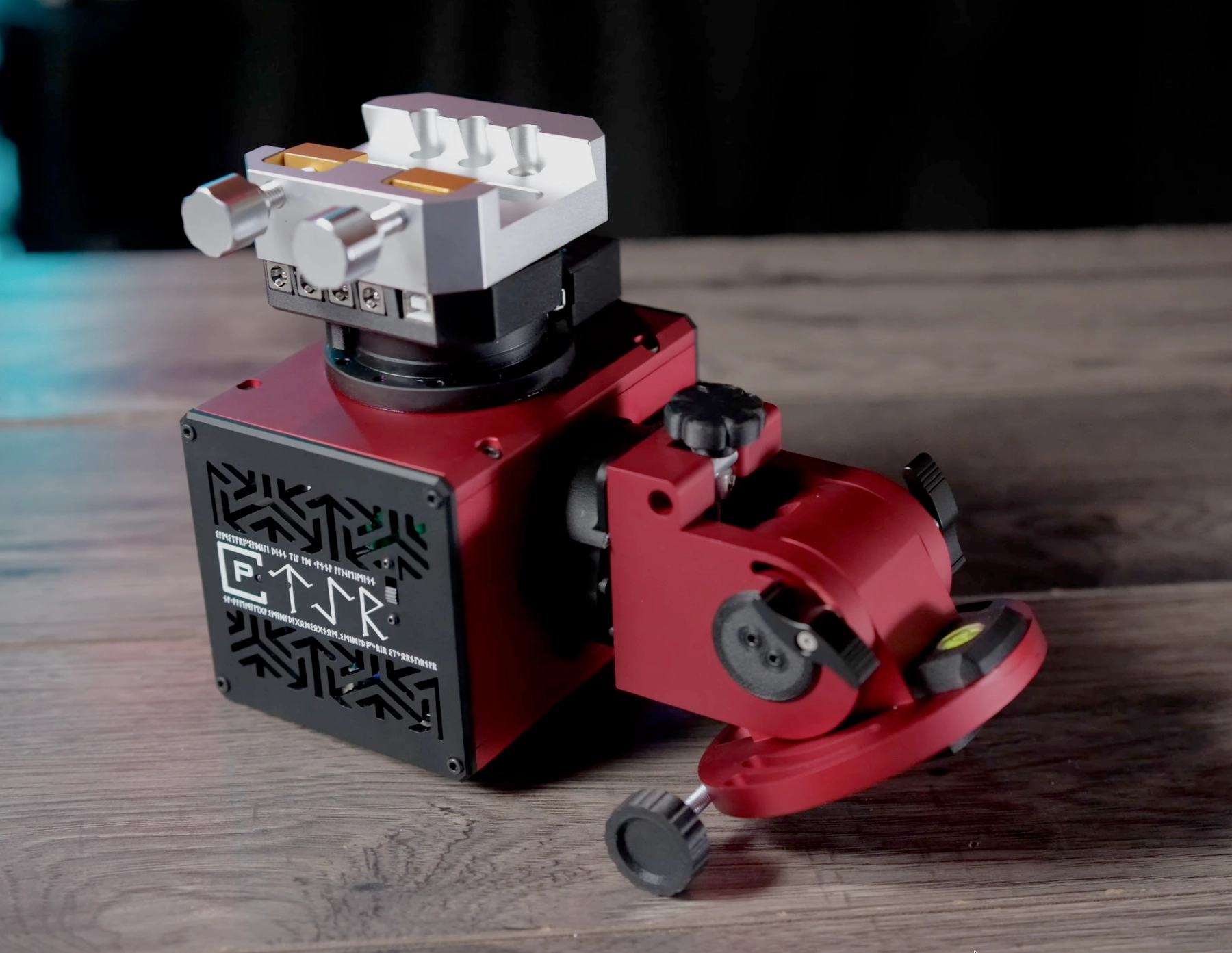
The Prometheus Astro Týr puts the advantages of harmonic drive technology into practice. With a compact 5.1 kg mount head, up to 20 kg payload capacity without counterweights, and a combined reduction ratio of 750:1 in Right Ascension, Týr is engineered for demanding deep-sky astrophotography.
Its precision drive system, automatic homing, integrated cable management, and ASCOM/INDI compatibility provide a complete platform for modern imaging workflows.
Explore the Prometheus Astro Týr Harmonic Drive Mount
The Reality Check: No Technology Is Magic
Harmonic drive mounts aren’t perfect, and understanding the trade-offs helps users get the best out of them.
Periodic Error (PE) in a harmonic drive mount tends to be higher than worm mounts
A typical harmonic drive has a higher PE amplitude, though the error is smooth and predictable. Good guiding can easily compensate—as long as guide exposures are short (0.5–1.5 seconds is common).
They demand realistic balance expectations
Perfect balance is less critical than worm gears, but extreme imbalance can still make guiding harder, especially in windy conditions.
Payload ratings vary between vendors
Many manufacturers quote optimistic numbers based on robotic applications, not astrophotography. Real-world payload should be evaluated based on the imaging load, not just the mechanical rating.
Guiding Expectations: What’s Realistic?
With appropriate guide settings—short exposures, modest RA aggression, slight backlash compensation—modern harmonic mounts regularly achieve:
- 0.4″ to 0.9″ RMS under average seeing
- consistently stable RA response
- predictable periodic error that responds well to PHD2 corrections
This is why harmonic drives have become the default choice for traveling astrophotographers and anyone who wants a full imaging rig in a backpack.
The Prometheus Astro Týr as an Example
The Týr mount is built around precision harmonic drives with 750:1 RA and 400:1 DEC reduction, offering:
- compact form factor
- high stiffness
- robust tracking for long-focal-length imaging
- sub-arcsecond guiding under realistic sky conditions
The goal isn’t to hide the nature of strain-wave gears in a harmonic drive mount, but to engineer around it—embracing their strengths while minimizing their quirks through smart mechanics, careful reduction ratios, and tuned firmware.
Should You Choose a Harmonic Drive Mount?
You’ll probably love a harmonic mount if:
- you value portability but don’t want to sacrifice performance
- you observe from rooftops, balconies, or dark sites where setup time matters
- you want a counterweight-free or low-weight system
- you plan to guide often and appreciate smooth error curves
If your priority is unguided imaging for long focal lengths, a high-end worm mount may still shine. But for the majority of modern astrophotographers—especially mobile imagers—a harmonic drive mount is a remarkable combination of engineering efficiency and practical performance.
Final Thoughts
Harmonic drive mounts are more than a trend; they’re the natural evolution of precision tracking. The combination of stiffness, negligible backlash, high reduction, and low weight aligns beautifully with the demands of today’s imaging workflows.
As strain-wave technology matures and mount designers tune their implementations, we’re entering a new era of portable astrophotography—one where small doesn’t mean compromised.